



AI is no longer something to keep an eye on. It is already changing how customers find businesses, how quickly competitors respond, and how much work a small team can carry.
The businesses that benefit are not the ones using the most tools. They are the ones that know what they want AI to do, and have connected it to how the business actually runs.
What has actually changed
Three shifts matter for almost every business, whatever the industry.
- Customers ask before they click. More people put a question to an AI assistant or an answer engine before they ever open a website. If your business isn't clearly described, accurate and easy for those systems to understand, someone else gets named in the answer.
- Routine work no longer needs a person to move it along. Drafting, summarising, reporting, follow-ups and scheduling can be prepared in the background, so your people spend their time on decisions and relationships.
- Expectations have moved. Customers have come to expect faster replies, clearer information and a more personal experience. They compare you with the best experience they have had anywhere.
The risk isn't AI. It's drift.
Doing nothing is a risk, because the gap widens a little every month. But the opposite mistake is just as common: a scattering of subscriptions, a few experiments, output that doesn't sound like you, and nothing connected to anything else.
Staying current doesn't mean chasing every new tool. It means deciding where AI creates real value for your business, putting it there on purpose, and keeping a person in charge of the decisions that matter.
See what this could look like for your business.
A discovery call is a conversation about what you're working toward. We'll start with the opportunity, and tell you honestly where we think AI can and can't help.
Five places AI creates real value
Start with the question, not the tool. These are the areas where we most often see a clear return, with a question to ask about each.
1. Being found and understood
Search is turning into answers. Clear, accurate, well-structured content, with questions answered the way customers ask them, helps both search engines and AI assistants represent you correctly.
Ask: If someone asked an AI assistant who solves the problem we solve, would it describe us accurately?
2. Responding faster
The first reply sets the tone. Inquiries, phone calls and follow-ups can be handled, drafted and routed quickly, with a person approving what goes out.
Ask: How long does a new inquiry wait before someone answers it, and what happens when nobody is free?
3. Producing consistently
Content, proposals and reports take time mainly because someone has to start from a blank page. Systems can plan and draft ahead, in your voice and from your facts, for a person to review.
Ask: What do we keep meaning to publish or send, and never get round to?
4. Seeing clearly
Most owners piece together how the business is doing from five different places. A single view of what is open, what is late and what needs a decision turns a morning of checking into a few minutes.
Ask: What do I need to know each morning, and how long does it take me to find out?
5. Removing friction
Invoices, reminders, scheduling, data moving from one system to another. Work like this rarely needs judgement, only reliability.
Ask: Where is someone on our team simply moving information from one place to another?
Four questions before you adopt anything
Before any tool, project or subscription, answer these.
- What outcome do we want? Name it in plain words. "Reply to every inquiry the same day" is an outcome. "Use AI" is not.
- Who owns it? Someone should be responsible for how it performs, not only for switching it on.
- What stays human? Decide in advance which decisions, messages and approvals a person always makes.
- How will we know it's working? Choose one thing to look at after a month.
See it in practice
We design and build intelligent systems, and we use the same thinking on our own work. Each of these started with a business challenge, then put automation where it removes routine work and left the decisions with a person.

FYND: talent discovery and comp cards
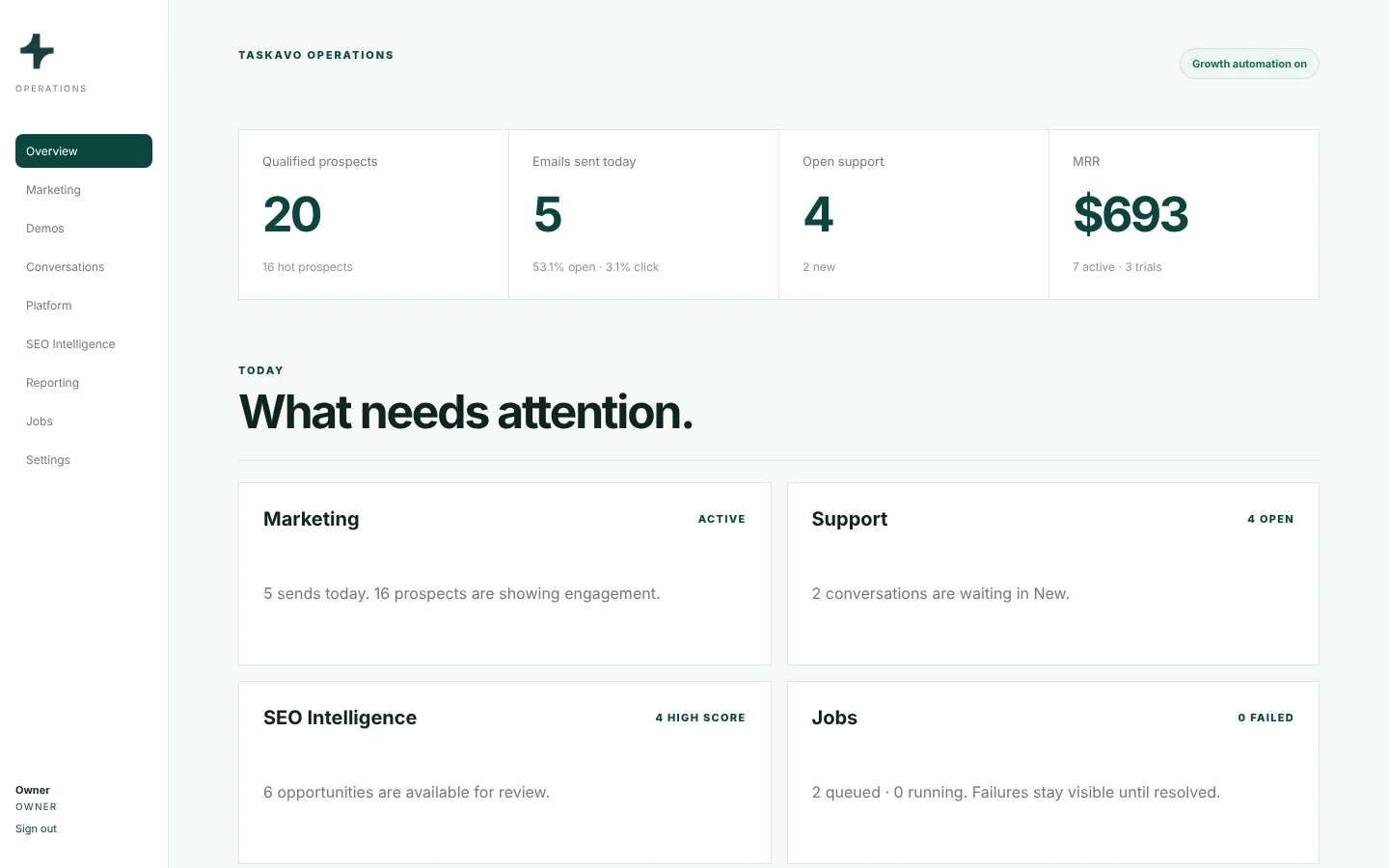
Taskavo: one control centre for marketing, support and billing
Squarebook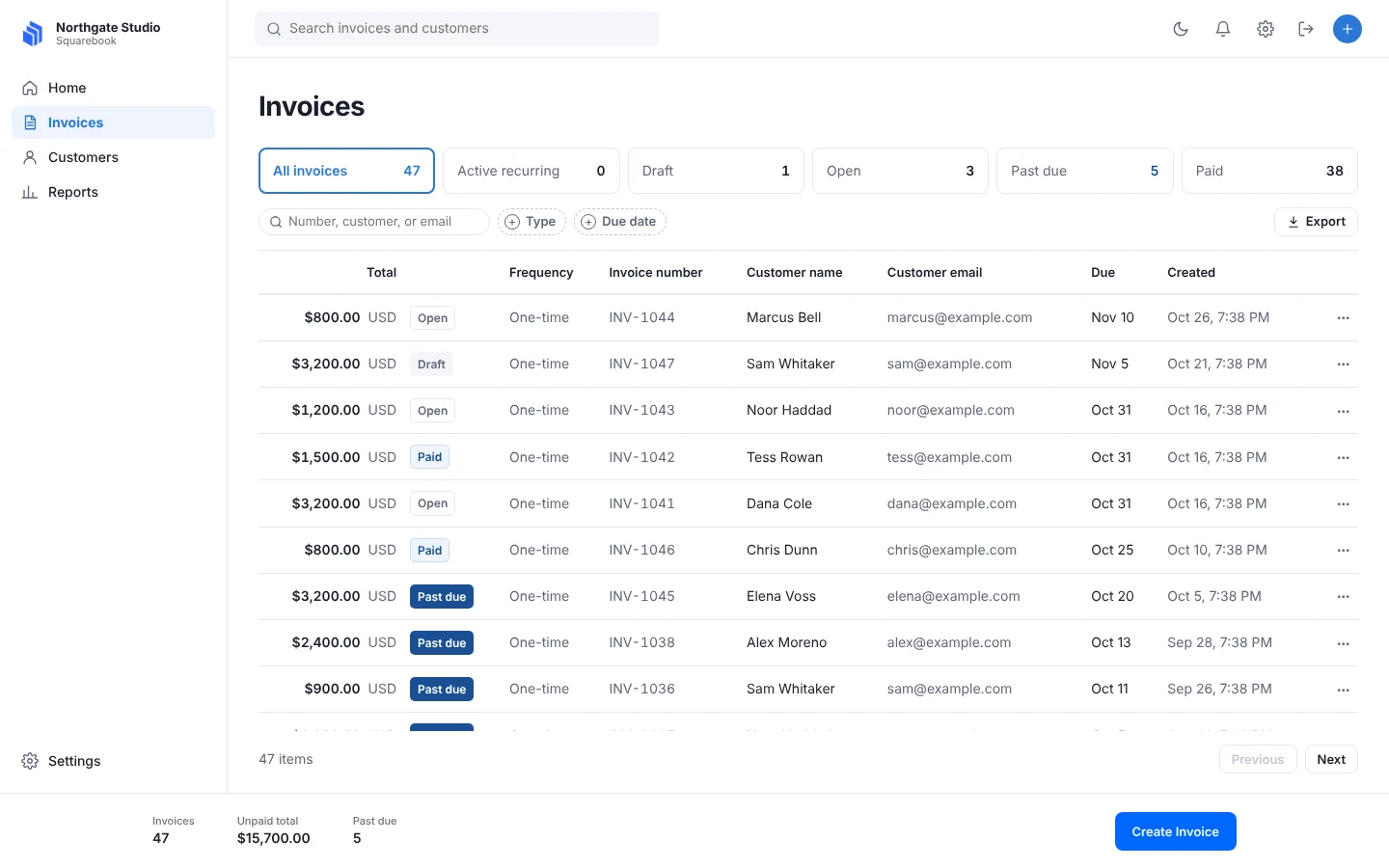
Squarebook: invoicing and payments, made simple
- FYND connects modeling agencies with talent who chose to be found, with safeguards built in: under-18 profiles are never contacted, people can opt out, and email volume is limited.
- Taskavo runs marketing, support and billing routines in the background and puts only the decisions in front of a person, with a visible history for every automated task.
- Squarebook follows the money for small businesses: payment links, automatic matching of payments to invoices, and a clear view of what is open and what is late.
A month to get started
You don't need a large programme to begin. You need a short list and one honest pilot.
- Week 1: map it. List the tasks that repeat, and every point where a customer waits for you.
- Week 2: choose one. Pick the item with the clearest outcome and the lowest risk if it goes wrong.
- Week 3: pilot it with approval. Let a system prepare the work and have a person approve it before anything goes out.
- Week 4: review. Look at what changed, what needed fixing and what to do next.
If you would rather not do it alone, that is exactly what a discovery call is for.
FAQ
Frequently asked questions
Do we need to use AI everywhere?
No. Use it where it solves a real problem for your customers or your team. Starting with one well-chosen use is better than five that nobody owns.
Will AI replace our team?
The aim isn't to remove people from the business. It's to take routine preparation off their plates so their time goes to judgement, relationships and decisions. We design systems so that a person approves anything that reaches a customer.
How do we keep customer information safe?
Decide what the system needs to know before you connect it, limit access to that, and keep a person in charge of what is sent. Opt-outs and sending limits should be built in from the start, not added later.
Where should we start if we have no idea?
With the business, not the technology. Write down the outcome you want and the places where work or customers wait. That list is enough for a useful first conversation.
What happens on a discovery call?
It is a conversation about your business and what you are working toward. We ask where the constraints are, how the market is changing and what meaningful progress would look like. Then we tell you where we see the opportunity.
How is this different from buying AI tools?
Tools do a task. A strategy decides which tasks matter, connects them to how the business works and keeps people in charge. We start with the opportunity and put the right capabilities in place to bring it to life.